
An Homage to Dialectics
And to Dialectical Behavioral Therapy

Dialectics have changed my life.
Put simply, the Dialectic is the idea that two (seemingly contradictory) things can be simultaneously true. It’s a simple idea, and as I hope to show, a powerful one. I credit my individual therapist, my group therapist, and Dialectical Behavioral Therapy (DBT) for inculcating these ideas in me, and I also recognize that the seeds and harvests of dialectical thought go much further back, both in my life and in the history of human thought. I would say I’ve been a pretty dialectical thinker for a while, and that the philosophical, psychological, and spiritual education I’ve received, formal and not, has both honed my understanding of dialectical thinking and broadened my application of it.
I’m sharing this because I think DBT is so helpful for becoming better in many senses of the word, especially for people like me who can face a lot of emotional and physiological distress. I’ve felt that in myself and seen that in others who have gone through the program with me. At the same time, I resist the idea of limiting therapies and their insights to “pathological” individuals—I think we can learn from the idea that there is no such thing as mental illness. We all, as individuals and collectives, face stressors and traumas and must navigate difficult situations. I believe that the world would be much improved if every individual, collective, and organization was able to learn and apply dialectical thinking and DBT skills.
My Individual Story
The precipitating event for getting me into DBT was that I got into a serious conflict with one of my best friends (we’re good now). That rarely happens to me, and in that moment, I really thought I had lost him. Imagine (if you’d like) that you’re me, fresh out of college with no job, humiliated and anxious and self-hating, and you think this guy who is one of your best friends and who you’re probably still in love with hates you and never wants to talk to you again and that maybe it’s sort of your fault. I’m just thankful that my therapist and my other friend were there to talk me through the worst of it, because I don’t know what I would’ve done to myself without them.
That was the precipitating event. And it was merely one peak of years of a building storm. At risk of repeating myself, I’ve had sustained bouts of intense anxiety, depression, self-loathing, anomie, and rumination, which have periodically culminated in (something bordering on) a mental breakdown.
It wasn’t like I ignored the problem. I’ve been in therapy since I was in high school. My therapist then had taken a cognitive-behavioral approach. My neuroses at the time were mostly nonsensical, often fixating on fears of the supernatural and the highly unlikely. He would say, “but really, what are the odds?” or “let’s be scientific about this.” This is not to blame him—that is merely the standard of care in cognitive-behavioral therapy, and CBT is a generally effective therapy. And at the same time, I don’t think it fully addressed my neuroses (and those of many others like me) on a deeper level. And so they have continued to reappear, merely taking different guises than they did before.
Because to treat all neurosis as a problem to be fixed is like treating all paranoia as the product of delusion. What happens when it is in response to something real? What if it’s actually true that horrible things happen out of your control, that someone doesn’t care about you, that you’re actively in danger, etc.? Clear and honest reasoning loses the power to deny these realities, as it should. And that necessitates a more dialectical approach.
Dialectical Thinking and DBT
Dialectical thinking—or the idea that term represents—embraces contradiction as a part of and a process towards a greater synthesis. Perhaps the most forceful representation of this is the Buddhist Chatushkoti, or Fourfold Negation, which is that things may fall into 4 categories:
P
not(P)
P and not(P)
not(P and not(P))
It is interesting that the first two propositions are incredibly fundamental to us Westerners (as truth and falsehood), while the last two are so incredibly alien. One might say that the last two categories are just nonsense; how could something be true and false? Yet one might criticize at least the second proposition on similar grounds—how can something real be false, or how can something (which inherently seems to self-evidently imply some sort of existence) not exist?
My guess is that something like the third (and maybe fourth) category was developed in the “West” by Hegel (or the popular interpretation of Hegel) through the idea of the thesis-antithesis-synthesis, where from a thesis (P) arises its own antithesis (not(P)), which together form a synthesis (P and not(P)). Importantly, there is nothing that has to come “from outside” to effect this movement, just as nothing must come from outside the physical universe to cause the motion we observe.
These developments foreshadowed the development of similar ideas early psychology. It was especially present in the ideas of Carl Jung, who developed the ideas of enantiodromia, holding that from some trait, drive, or focus arises an unconscious opposite, which, in time, becomes conscious to restore a kind of balance. So from intense care for others may arise resentment and callousness, and from intense trauma may arise post-traumatic growth. Now, I don’t think we need to be going full Saw on people, and I think this illustrates the one-sidedness of a black-and-white division between “good” and “bad” qualities.
And that leads us to DBT, which does not make a priori assumptions about what things are good or bad, or even that things are categorically good or bad at all. Rather, one of the foundational assumptions is the question of “how does this serve you (in this context)?” Because doesn’t it make sense that the things we’ve evolved have some value to us to have made it this far? Our culture had taught me to disdain and loathe those parts of myself which made trouble: the anxiety, the depression, the hypersensitivity, the psychic pain. DBT invited me to think in another way: to be curious and compassionate. All parts of me—the reason and the emotion, the body and the mind, and everything in between and other—are valid. They are trying to tell me something. Maybe they aren’t entirely on the mark, and maybe if I’m not careful I could respond ineffectively. And. Maybe if I sit with them, listen to them, have a dialog with them while also not rushing to be overwhelmed by them, maybe they will help guide me to something better. Or at least to avoiding something that could make things worse.
It’s not about some principles of what’s pathology or who is mentally ill or recommending some one-size-fits-all treatment. Different situations and people call for different skills. And you can use skills to reduce distress and promote wellness whether or not the primary “underlying cause” is “from within” or “from without.” It is an explicit principle of DBT that it is all about being effective. No matter whose “fault” it is, no matter whether you acted rightly or wrongly, no matter whether you could’ve avoided a bad outcome or if the world was just set up for you to fail, what can you/we do to make things better, to ease the suffering, now and for the future? And of course we want things to turn out for the best, and it’s still good if we can make things better, or keep things from getting worse, or even just make it through some situation. I really, really love this compassionate and effective principled unprincipledness, and I wish we had more of it both in therapy and in the world at large.
Western Thought and Dialectics
I begin with a bold claim that “Western” thought has developed a quite anti-dialectical streak.
This goes all the way back to the eras of Aristotle and Plato and the very origin of classical Western logic. Here developed a proclivity towards making sharp, crisp claims which stand on their own and which do not contradict themselves or one another. Such things as “law of the excluded middle” and the “principle of explosion” form part of the bedrock of classical Western logic. This has been highly useful. And it is just one way of thinking, for other systems of thought, like Buddhist logico-epistemology, appear much more dialectical. This is perhaps an antithesis, if there is one, to the “Western” logical way of understanding.
One may wonder how “real” these differences in thinking run and how “deep” they are. A paper I read in my cultural psychology class called “Culture and Systems of Thought: Holistic Versus Analytic Cognition” (Nisbett et al., 2001) provides evidence that the differences are pretty real and run pretty deep. I think it is worth reading directly in its entirety, but to summarize some of the most relevant points, it demonstrates significant differences between the ways in which modern American (representing the relatively analytic) and modern Chinese (representing the relatively holistic) people think. Notably, Americans tended to rely more on formal logic, to prefer more dispositional/individualistic focuses, and to “take a side” (accepting one cause and rejecting the other), while Chinese tended to rely more on experience, to prefer a greater focus on contextual/collective factors, and to use dialectical reasoning to attempt to reconcile apparent contradictions, placing weight on multiple factors. The researchers even report differences at the level of perception, such as perceived control, responses to Rorschach tests, and detection of covariation of stimuli.
I mentioned earlier that the analytic, “Western” mode of thinking might have been critical to the development of much of modern science, and I believe this is true. And at the same time, Nisbett et al. make a good case that holistic thinking may have been comparably crucial in its own way. It was holistic thinking that led to the invention of the concept of 0, the invention of the printing press, and the understanding of field-based forces like electromagnetism. Arguably, the current trajectory of AI development has seen the triumph of associative models over those based on symbolic logic, perhaps another point for holism?
One might also believe that the worst excesses of overanalytical and/or underholistic thought merely affect the unintelligent or uneducated. Perhaps a greater propensity towards cognitive reflection would temper this. Two things are worth noting here. First, Nisbett et al. provide some evidence that the “Western” population generally (not just highly intelligent people) does supplement with holistic reasoning in many cases. Second, drawing on my experience and anecdotes, a disproportionate amount of “pathological hyperrationality” seems to have come from highly educated Western communities (including the self-proclaimed Rationalists). Many influential Western philosophers (epitomized by Kant) have distinguished between experience and principled, a priori reason and favored the latter to exclusion or diminution of the former. And neoclassical economics—created and maintained by some of the most WEIRD, intelligent, well-educated elites stretching back generations—is majorly critiqued by many for being too theory-heavy at the expense of reality. So I think it’s reasonable to say that pathologically overanalytical and underholistic thinking is at least as present, if not more, among the highly educated and highly intelligent elites of Western society.
Dialectics, Metacognition, and Equilibria
I might be giving the impression that holistic or dialectical thinking is categorically better than analytical thinking, but I think to say so would be to make a few errors. As noted by Nisbett et al., the distinction between analytic and holistic should be understood as a pragmatic distinction; it is useful to create these categories, and at the same time there’s no label hovering above peoples’ heads that says “analytical” or “holistic.” We should also be wary of dichotomizing people; people might fall along a spectrum or cloud in the ways they tend to think, and their thinking may change in different times and situations. And of course, different contexts may tend to call for different ways of thinking. Perhaps, however, the irony is not lost that these cautions are ones which are more typical of holistic thinking and less of analytic thinking.
Analytic thought might be likened to a double-edged sword (which is really all swords, right?): at its best, it is a powerful moral force which has made democracy and universalizing social movements possible, and at its worst, it is a powerful moral force which has made totalitarian, extremist, and (also) universalizing ideological movements and regimes possible. It is a sharper, harder instrument, useful for slicing and dividing and prying and also brittle, explosive, and deadly. It is more active and more controlling, and that cuts both ways.
So as Nisbett et al. note, it is not that one “way of thinking” is better than another, but that these traditions and elements of them all hold some value and that it depends on the context. A hammer is for hammering nails, a wrench for twisting washers, and a knife for cutting vegetables; it is in some sense foolish to think of one as better than another, or to think that some abstract “average” of a hammer, wrench, and knife is the best thing in all cases. And this is where Derrida’s injunction returns to us: now we are thinking about thinking, much like that M. C. Escher piece which depicts hands drawing hands drawing. And we may think about thinking about thinking, and so on, and there is no end no matter how far we go.
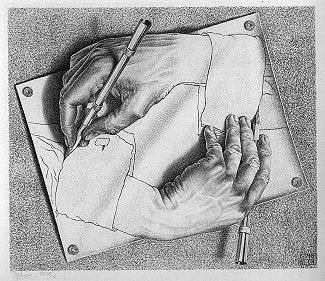
I think this metacognition is uncomfortable for us because it makes us feel untethered: we are used to having a metaphorical bedrock to stand on, some unchanging axioms from which we can derive the rest of the universe. But those axioms might be “wrong,” in which case, we need to “pop out” to reason about the system itself, but then we must still use some axioms, and so on, so where does it end? One of the ideas which has really helped me came from Douglas Hofstadter’s Godel, Escher, Bach (which I’m hopefully not badly butchering here) and it is called the Rule of Fantasy. The interesting part is that at the “base level,” you can start with no axioms. Then you can “pop into” a temporary/hypothetical level to assume a statement and use that assumption to create a derivation, which can then be carried back into the original level of reality. A simple example is to start with nothing, then pop in a level and imagine that some proposition P is true, and reason by double negation that this implies not (not(P)) is true: so we are saying that if P is true, then not(not(P)) is true without claiming at base level anything about the truth-value of P. It feels like instead of building a logical Tower of Babel, one is dancing with dialectics. There are no eternal, universal axioms: we leap from system to system, from synthesis to synthesis, and say “what if we assume this; then what would happen?” popping out and in and out again.
Sorry non-math folks, but I promise there’s a point here. For this connects to a pragmatist view, one that permeates DBT and which my therapist frequently reminds me of, which is: “what is the story you’re telling yourself?” and its complement, “what if you were to tell yourself a different story?” As a simple example: I get anxious about a lot of things. Sometimes the temptation is to either acknowledge the anxiety and totally reify it (e.g., I’m really going to die/fail/feel horrible about this) or to deny the validity/existence of the anxiety at all. Dialectical thinking can forge a new path: I can ask myself, “sure, I feel anxious now; and what if I felt less anxious about it? What if I changed my assumptions about some situation or how I should react to it? Would that still work for me? Would it be better?” And the thing is that a lot of the time, that works. I see the situation in a different way—more clearly, calmly, and compassionately—without losing sight of how I felt before and why.

A Dialectical Society
Why do I think the value of dialectical and holistic thought extends beyond the therapeutic?
I believe dialectical thinking—or the essence of the idea represented by that term—is powerful because of its radical flexibility. It’s flexible enough to free us from bad patterns without being purely or excessively destructive. In the “Western” tradition of reasoning, there can be no contradiction—one must master the other, and all must be controlled. It is a focus on order above all else. This leads to a lot of tension and brittleness, which eventually explodes; or perhaps it implodes, collapsing under its own weight. Dialectical thinking changes from this. If it is about anything, it is about harmony and compassion, aiming for the satisfaction of the collective well-being as well as the satisfaction of the individuals who compose it through an open and consensual mutual exchange. This might be most readily apparent within a group, where a team works well to distribute costs and benefits with greater productive conflict and less destructive conflict. It can also be seen within individuals, who may wish to arbitrate between different drives and aspects of themselves. And it may extend to yet higher levels, such as those of societies and ecologies. I want to stress once more that this is not (merely) about achieving order—individuals, societies, and ecologies may be stable without being very good, and in this way stability may actually be a threat to well-being by perpetuating an undesirable state of things. It is about welfare, wellness, and well-being, with the deep awareness that the world and our understanding of it are always changing.
And—perhaps dialectically—I know I ultimately draw this from my own experience. I believe Dialectical Behavioral Therapy really helped me and did so in the way that it promised. It didn’t make all the pain go away; nothing can do that. And at the same time, it changed me for the better. I still have times of great turbulence, and I know I will in the future. And I have become better at dealing with them. I use skills to tolerate distress and reduce intensity more often. I am kinder to myself and more willing to reach out for help. In general, I act more effectively in response to chaos—I am not just afraid; I am also curious and attentive and compassionate. It did not make things perfect, and it did make them better. And I think, here and now, that that is a better thing to aim for, both for ourselves, and for the world.